
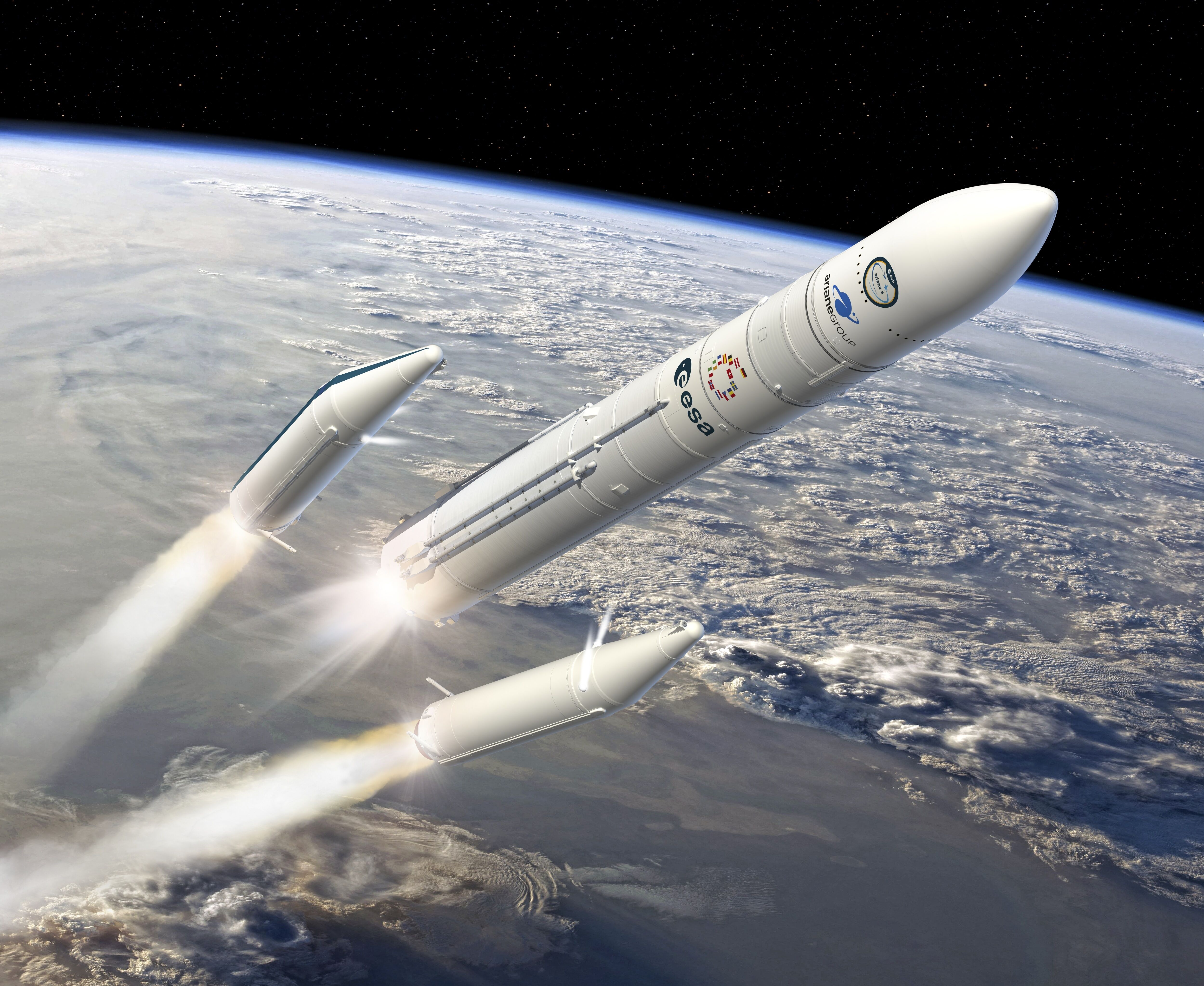
Launch update, 9 July 16:00 CEST: Watch the live launch broadcast of Ariane 6 on ESAWebTV. The launch is currently scheduled for 9 July 2024. Liftoff is now scheduled no earlier than 16:00 local time (21:00 CEST), with the live stream starting at 15:30 local time (20:30 CEST).
Excitement is building for the Fly Your Satellite! teams ISTSat-1 and 3Cat-4 (“cube-cat-four”) as they prepare for their crafts to be launched into orbit! The satellites will be carried on the first flight of ESA’s new Ariane 6 rocket, making this a truly once-in-a-lifetime experience.

Lift-off is currently scheduled for 9 July 2024 from Europe’s Spaceport in French Guiana. This will mark the culmination of years of hard work from the student teams, who have designed and built their satellites with support from ESA experts.
The journey of these satellites to this point began when the two students teams fought off intense competition to be selected for the second edition of ESA Education’s Fly Your Satellite! programme. Years of hard work followed to produce robust and effective designs, and then turn these into fully-functional satellites. ESA experts have been on-hand throughout to offer guidance, and the teams have also travelled to ESA sites such as the CubeSat Support Facility in ESEC-Galaxia, Belgium for thermal vacuum and vibration tests, among many others!

ISTSat-1 will be the first-ever CubeSat built by a university student team in Portugal (Instituto Superior Técnico in Lisbon) to be launched to space. It is tiny – a cube with edges just 10cm long, and weighs a little over 1kg. In addition to its primary educational objective, its mission is to carry out a feasibility study into the use of nanosatellites to track and characterise transponder signals of aircraft over remote areas, such as oceans. Given that three-quarters of our planet is covered by water, where there are many blind-spots where aircraft cannot be tracked by conventional means, the benefits could be significant.

3Cat-4 has been developed by students working in the Nanosat Lab, an initiative from Spain’s Universitat Politècnica de Catalunya. The satellite’s main mission is to teach the students about flying a space mission, as well as encouraging high-level teamwork. 3Cat-4 also has science objectives, focused on Earth Observation, one of which is measuring important climate variables using a technique called Global Navigation Satellite System Reflectometry. This involves measuring signals reflected from orbiting Global Navigation Satellite Systems, such as Galileo and GPS, that bounce off Earth’s surface.
Launching a satellite is an incredible moment, but having one you have designed and built yourself carried into orbit aboard the maiden flight of an Ariane 6 is an experience these students will never forget!
Watch the entire launch live on ESAWebTV, starting half an hour before liftoff. The transmission is available in English with commentary by Katy Haswell and ESA Ariane 6 launch system engineer Tina Büchner da Costa. French commentary is provided by Lise Pederson and ESA’s head of Infrastructure and value chain for Space Transportation Luce Fabreguettes. A German live translation is available here.