
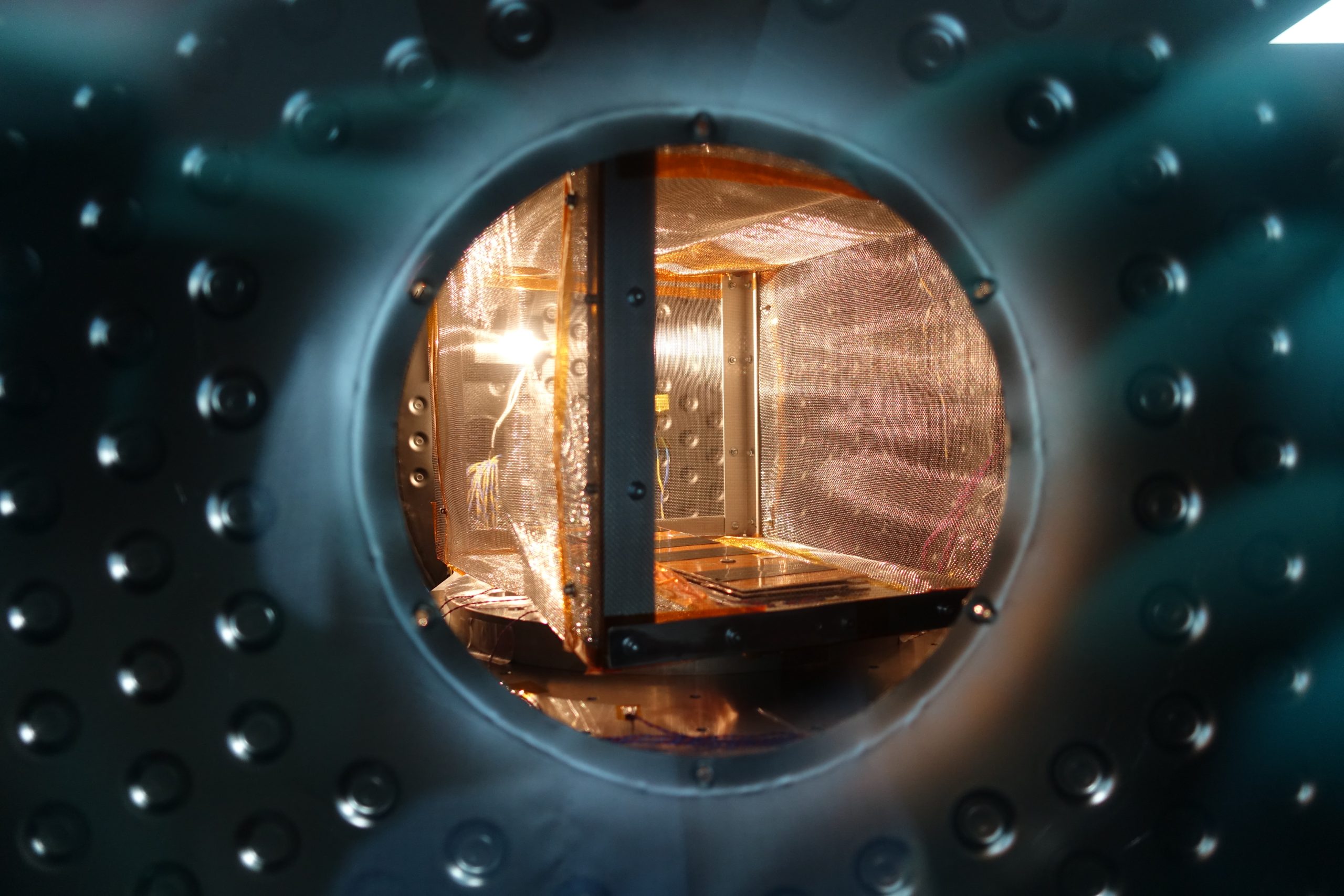
From the 16th to 20th of July 2025, the SOURCE CubeSat team from the University of Stuttgart conducted an environmental test campaign at ESA’s CubeSat Support Facility at ESEC-Galaxia in Libin, Belgium. Their goal: qualify the satellite’s in-house designed solar panel deployment system, marking a pivotal step forward in the satellite’s journey to space.
Pushing the boundaries of student innovation
The SOURCE team is currently in Phase D of their CubeSat development, focused on final design, integration, and testing. Their satellite is a 3U CubeSat equipped with a custom-built solar panel deployment mechanism — a feature that, once in orbit, will be vital for the satellite’s power generation and overall mission success.
This test campaign, executed within a single intensive week, was conducted under ESA Academy’s Fly Your Satellite! initiative, which offers student teams access to professional-grade testing environments.
Testing under space-like conditions

The SOURCE team’s test campaign consisted of two major components:
-
Vibration Testing: Simulating the mechanical stresses of launch to assess the structural integrity and deployment reliability of the solar panel deployment system.
-
Thermal Vacuum Testing (TVAC): Exposing the deployment system to the extreme temperatures and vacuum of space to ensure operational performance in orbit.
After four thermal cycles simulating the harsh temperature fluctuations in space, the in-house deployment system successfully activated during the fourth thermal cold plateau, validating its functionality under mission-representative conditions.
A milestone for confidence in orbit
This successful deployment marks a significant milestone for the SOURCE project. The confirmation that the system can deploy in a simulated space environment provides the team with confidence in the system’s performance once launched.
The experience also gave students a hands-on opportunity to engage in full-cycle environmental qualification testing — from cleanroom preparation and safety protocols to data logging, troubleshooting, and analysis.
“The successful deployment after the fourth thermal cycle is not just a technical achievement but a major confidence booster,” said a SOURCE team member. “It’s a green light to move ahead with satellite integration.”
Looking to the next phase

With the environmental test campaign completed, the SOURCE team is now preparing for the next step: satellite integration. This phase will bring together all the CubeSat subsystems, forming a fully assembled, flight-ready spacecraft.
ESA Academy congratulates the SOURCE team on their accomplishments and continues to support student teams pioneering sustainable, technically advanced space solutions.
About ESA Academy Fly Your Satellite!
The Fly Your Satellite! programme enables university student teams to gain direct experience in space hardware testing using ESA-standard facilities and procedures and exchanging with ESA experts on the development of their satellite. These opportunities are part of ESA Academy’s broader mission to train and empower the next generation of space professionals.
Click here, to learn more.
 English