
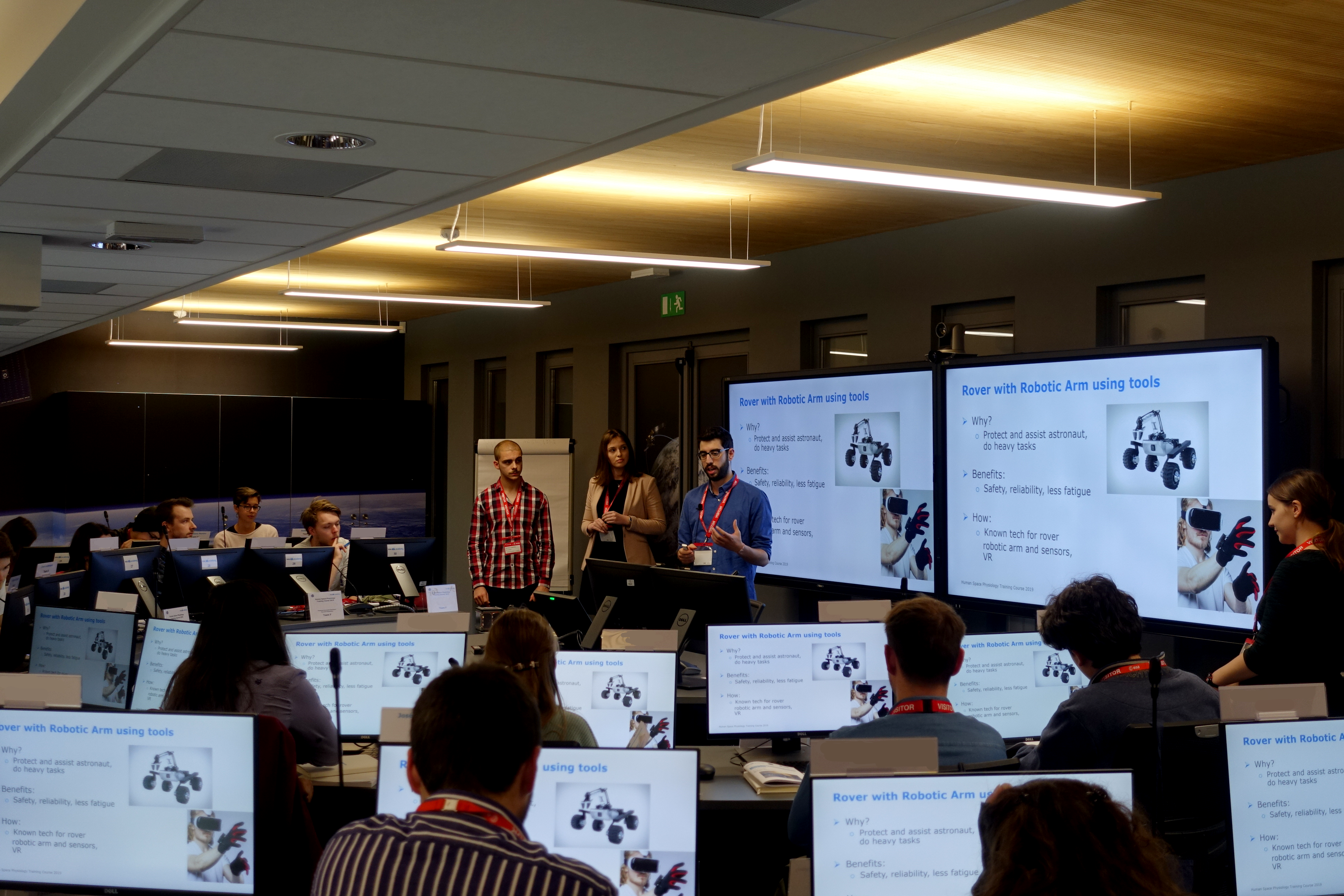
What is it really like to live in space? What happens to the body in microgravity? Thanks to a training course offered by ESA’s Education and Space Medicine Teams, medical and life sciences university students can find out.
ESA’s Education Office and the Space Medicine Team invite BSc and MSc university students studying medicine, allied healthcare subjects, life, biomedical or biological sciences to apply to the Human Space Physiology Training Course 2022. The course will be held between 28 November and 2 December 2022 at ESA Academy’s Training and Learning Facility in ESEC-Galaxia, Belgium.

Through lectures students will discover how spaceflight represents a significant physiological challenge to the human body. Having evolved in Earth’s gravity, our bodies adapt when in microgravity. Some of these adaptations may comprise astronaut health and wellbeing, either in flight or upon return to Earth. As a result, these adaptations must be understood to inform development of effective strategies to support humans during space missions to the International Space Station and beyond.
In addition to learning about life in space and the physiological adaptations associated with it, students will discover how a range of Earth-based analogues, such as long-term (head down) bed rest and over-wintering in Antarctica, are used to investigate some of the potential underlying mechanisms. Finally, current and some potential future approaches to mitigate the effects of the space environment on the human body will be discussed.
As part of the programme, students will work on a group project, addressing some of the major issues and challenges human spaceflight is facing. On the final day of the training course, each group will present their findings to the other participants.

Students participating in this training course can expect to be introduced to the following topics:
-
What it’s really like to live in space
-
The challenges, lessons, and successes that have led to permanent occupation of the International Space Station
-
The conditions that the ISS provides to protect and support life
-
How the senses perceive being ‘weightless’
-
How key physiological systems respond to microgravity, what mechanisms underlie these changes, and some approaches that may be used to mitigate such effects
-
How human space physiology research is performed both in space, and using Earth-based analogues
-
How astronauts’ physical and mental well-being is supported through ESA’s Space Medicine Team
-
Major issues and challenges current human spaceflight and future space exploration must overcome
Upon completion of the training course, students will be evaluated on their group project and will receive a certificate of participation as well as a course transcript, allowing them to request ECTS credit(s) from their respective universities.
Who can apply?
Students enrolled in university who fulfil the following criteria:
-
aged minimum 18 years old. ESA Academy and relevant partners will only appraise applications from students who have no or limited professional experience in relevant scientific or other space-related topics;
-
be a citizen of an ESA Member State, Canada, Latvia, Lithuania, Malta, Slovakia and Slovenia;
-
be enrolled as a BSc or MSc student (or equivalent) in a university for the year 2022-2023 (not graduating before the end of the training course);
-
be studying medicine, allied healthcare subjects, life, biomedical or biological sciences.
The selected students will be sponsored by ESA to cover accommodation and meals, as well as up to 300 Euros for travelling to Belgium.
How to apply?

-
Fill in the application form;
-
Upload a motivation letter (PDF, maximum 1 page, no images);
-
Upload a CV (Europass format, PDF, no images, maximum 2 pages);
-
Upload a formal recommendation letter (PDF, maximum 1 page, including signature, no images) from a university professor or an academic supervisor from your current university (if not possible to receive the recommendation letter from your reference, please ask them to send a recommendation email to tlp@esa.int before the application deadline);
-
Upload a copy of academic records (PDF);
-
Upload a short abstract (maximum 500 words) based on the title “Being in space can induce physiological de-conditioning”. Briefly define the major changes observed in a single physiological system (of your choice) and discuss whether this presents any issues for a mission to the Moon (PDF, no images).
All correspondence and documents should be in English (except academic records if not available).
The deadline for applications is the 3rd of October 2022 at 23:59pm CEST.
For more information, please contact: tlp@esa.int