
“Building STAR-D is more than designing an experiment—it’s learning how scientists and engineers from different disciplines become one team capable of sending biology to space”, STAR-D team
STAR-D experiment
The Space Test of Amoeba Response: Dictyostelium (STAR-D) experiment investigates a fundamental question in space biology: how does reduced gravity affect phagocytosis, the process by which cells recognise, engulf and digest foreign particles as part of the immune response?
During spaceflight, astronauts experience significant changes in their immune system, but the mechanisms responsible for these changes remain only partially understood. On Earth, gravity influences how cells and particles encounter one another through sedimentation and convection. In reduced gravity, these effects largely disappear, potentially changing how efficiently immune cells initiate phagocytosis.
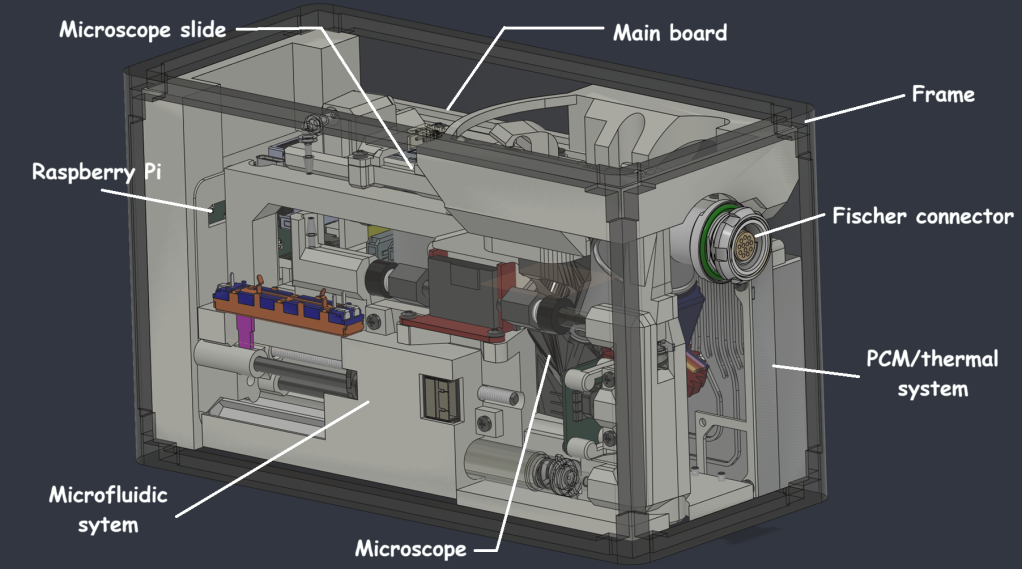
Rather than using human immune cells, STAR-D uses Dictyostelium discoideum, a well-established model organism that shares many cellular mechanisms with mammalian phagocytes while remaining simple, robust and safe for autonomous space experiments. By studying this analogue, the team aims to better understand the earliest stages of the immune response in space while demonstrating the potential of model organisms as an alternative to human immune cells for future biological research in orbit.
The experiment is housed inside a fully autonomous laboratory designed to operate from launch until recovery. Shortly before the reduced-gravity phase, fluorescent bacteria-like particles are automatically injected into a compact microfluidic chamber containing the amoebae using a precision syringe system driven by a stepper motor. As the particles are engulfed, they emit fluorescence inside the acidic digestive compartment of the cell, allowing phagocytosis events to be detected in real time without additional staining.
A motorised 40× fluorescence microscope, equipped with a Raspberry Pi V2 camera, continuously records bright-field and fluorescence images throughout the flight. The optical assembly is mounted on a dedicated passive vibration-isolation platform to withstand the demanding launch environment while maintaining image quality. The experiment is controlled by a Raspberry Pi Compute Module 5 together with a custom ESP32-based electronics system, enabling fully autonomous operation from liftoff to recovery.
The STAR-D team
STAR-D is developed by an international team of 17 students led by ESILV (Léonard de Vinci Graduate School of Engineering), France, together with students from Aalto University, Finland, Newcastle University, United Kingdom, the University of Vienna, Austria, Université de Bordeaux and AgroParisTech/Université Paris-Saclay, France.
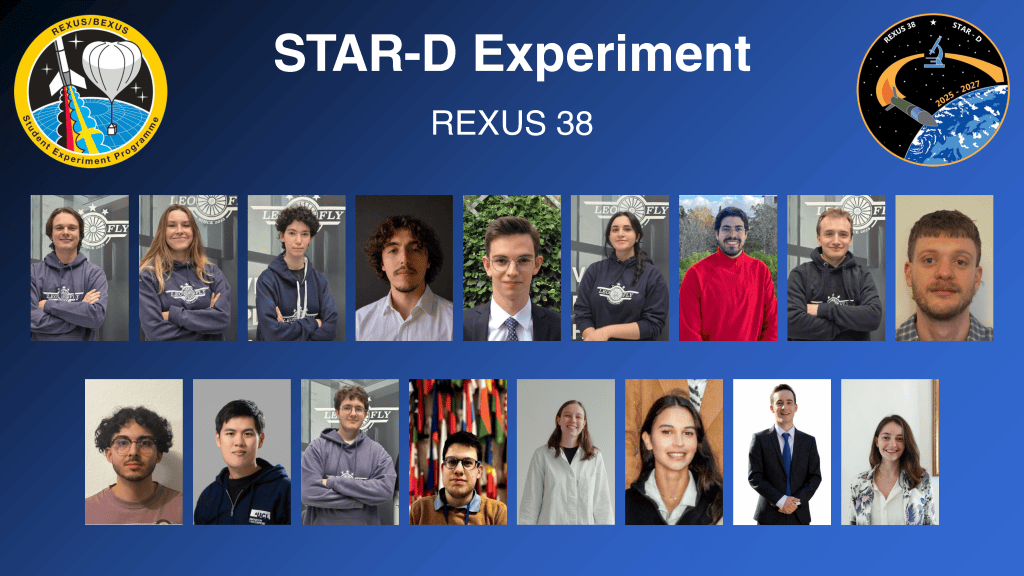
Bringing together Bachelor’s, Master’s and PhD students in mechanical engineering, electronics, software engineering, biology and outreach, the team combines expertise from six universities across four countries. Selected to fly aboard REXUS 38, STAR-D reflects the strength of multidisciplinary collaboration and aims to contribute both to our understanding of immune function in space and to the development of autonomous biological research platforms for future space missions.
STAR-D in a nutshell
| Experiment | STAR-D (Space Test of Amoeba Response: Dictyostelium) |
| Objective | Investigate how reduced gravity affects phagocytosis using Dictyostelium discoideum as an analogue of immune cells aboard REXUS 38 |
| University, country | ESILV (Léonard de Vinci Graduate School of Engineering), France International collaboration with: – Aalto University, Finland – Newcastle University, United Kingdom – University of Vienna, Austria – Université de Bordeaux, France – AgroParisTech / Université Paris-Saclay, France |
| Website | https://www.leofly.fr/stard |
| Social media | STAR-D on Instagram |
You must be logged in to post a comment.