
“REXUS/BEXUS has taught us things no lecture could.” CAPILUX team
CAPILUX experiment
In space, fluids do not behave the way they do on Earth. In microgravity, forces like surface tension and wetting become dominant. This makes managing fuel, coolant, and other fluids surprisingly difficult. Capillary structures are already used to move fluid without pumps, but there is limited real-world data on exactly how these structures affect fluid behaviour, and simulations become unreliable once the shapes get complicated.
CAPILUX, flying on REXUS 38, sets out to close that gap by testing a range of structures and studying how they handle fluid during the rocket’s reduced-gravity phase.

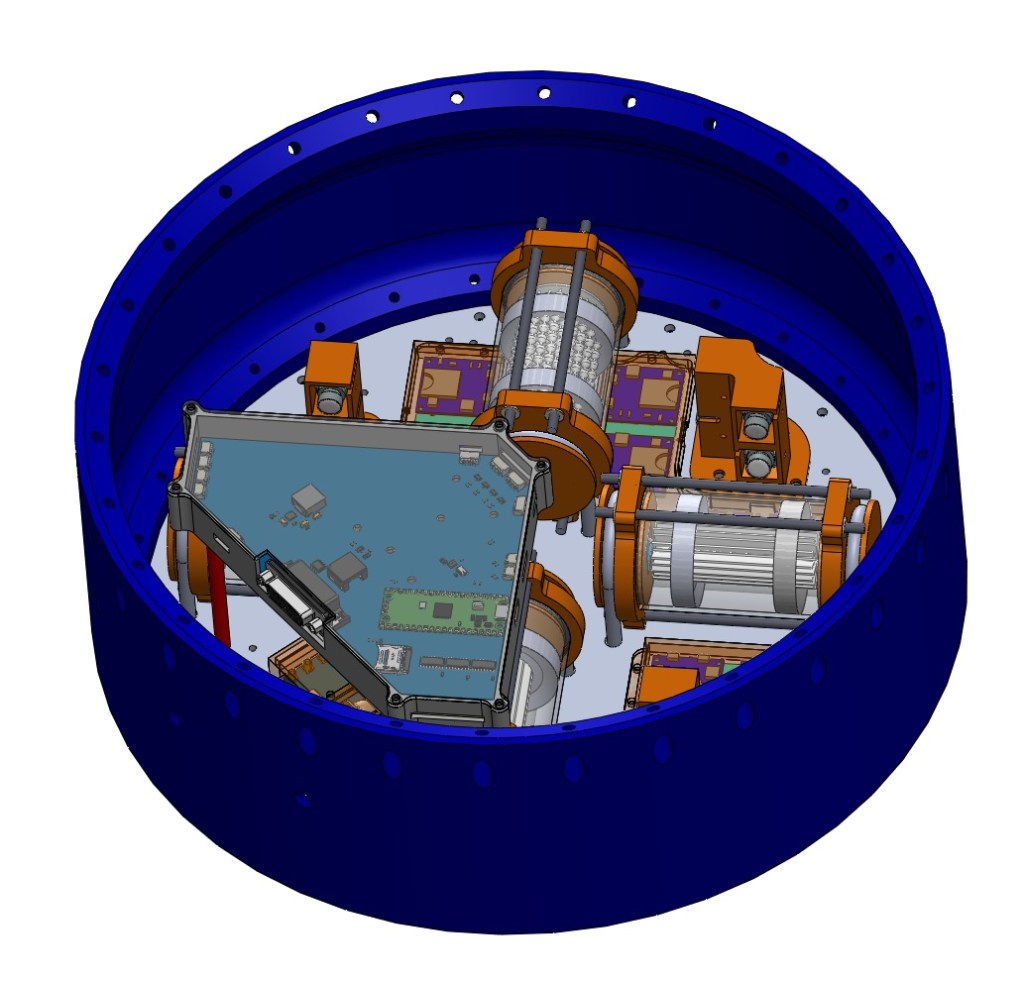
The experiment houses four sealed chambers, each with a different internal geometry, including a circular V-groove shape and a passive valve shape designed to block flow in one direction.
Each chamber holds a small amount of coloured water and is filmed by eight onboard cameras capturing the action from launch through the reduced-gravity phase.
As the rocket spins up and then slows its spin, the water is first pushed to the outer edge of the chambers; once it begins to float free, capillary action takes over, and the cameras record exactly how far and how fast it moves.
Sensors also track changes in temperature, pressure, and acceleration to support the science. Together, this lets the team compare how shape and surface properties influence capillary flow and build a dataset to test models for future passive fluid-management systems in spacecraft.
The CAPILUX team

CAPILUX is built by six students at Riga Technical University, the first REXUS/BEXUS team from Latvia, working out of the Aerospace Laboratory within the Institute of Mechanical Engineering, Aerospace Technology and Transport. The team includes students atbachelor’s, master’s, and PhD levels, with backgrounds in mechanical, electrical, and software engineering, plus materials and vacuum-testing expertise for the surface coatings.
The project grew out of RTU’s High Power Rocketry team, and one member’s master’s thesis feeds directly into the experiment’s fluid modelling. CAPILUX is scheduled to fly on REXUS 38 in 2027.
CAPILUX in a nutshell
| Experiment | CAPILUX (Capillary Fluid Transport and Passive Valve Behaviour in Microgravity) |
| Objective | Investigate capillary action in microgravity across a range of 3D-printed chamber geometries and surface treatments |
| University, country | Riga Technical University, Latvia |
| Website | CAPILUX website |
| Social media | CAPILUX on Instagram CAPILUX on LinkedIn |
You must be logged in to post a comment.