
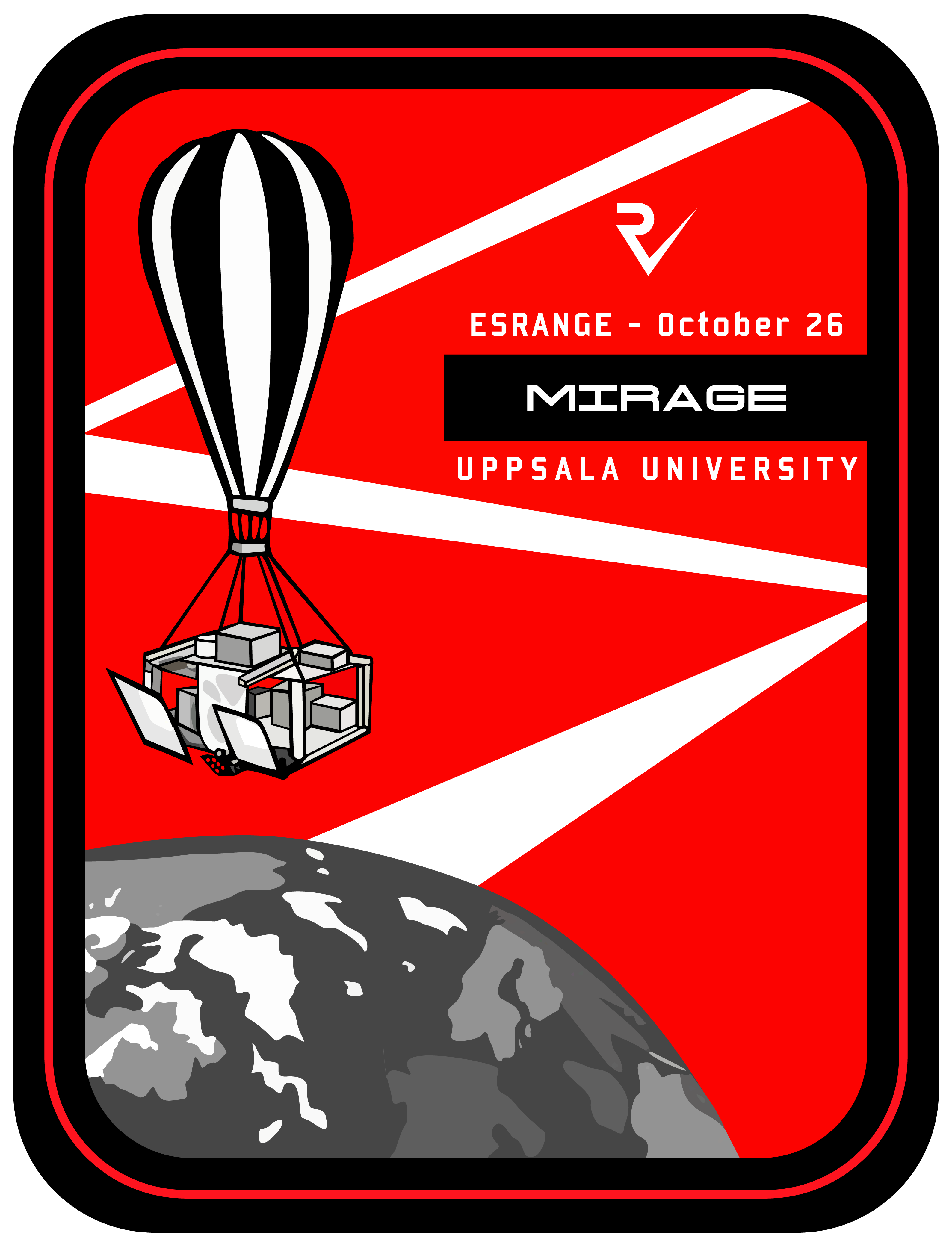
“I’ve learned in this one year in Rexus Bexus more than I learned in my 5 years of education”, MIRAGE team
From the oldest university in Scandinavia, MIRAGE (Methane InfraRed Absorption Gas Experiment) is Uppsala University’s first REXUS BEXUS project that is part of a consistent REXUS BEXUS team called RiseUpp at the university.
MIRAGE experiment

Methane is a potent greenhouse gas with a global warming potential approximately 28 times that of carbon dioxide over a 100-year period. Accurate monitoring of atmospheric methane is therefore essential, but current satellite-based approaches rely on atmospheric models that require in situ measurements for calibration. Such measurements in the stratosphere are sparse, partly due to the cost and complexity of existing laser-based sensing technologies, limiting model accuracy.

MIRAGE aims to demonstrate a low-cost alternative based on an off-the-shelf Non-Dispersive InfraRed (NDIR) sensor. To improve measurement accuracy, ambient air is temperature-controlled and pressurized before entering the optical chamber of the NDIR sensor. This experiment evaluates the limitations and potential of NDIR technology for stratospheric methane monitoring.
One challenge in measuring gases such as methane in the stratosphere is their low concentration, which decreases with altitude. MIRAGE therefore uses a pressurization system that pumps and compresses air into a pressure-tight chamber that contains the NDIR sensor.
The MIRAGE team
The MIRAGE team brings together around 30 students from different educational and technical backgrounds to work together and experience a real project cycle.
MIRAGE in a nutshell
| Experiment | MIRAGE |
| Objective | Demonstrate a cheap and effective solution for stratospheric gas sensing using a non-dispersive infrared (NDIR) sensor. |
| University, country | Uppsala Universitet, Sweden |
| Website | https://www.spacestudents.se/riseupp/ |
| Social media | MIRAGE on LinkedIn MIRAGE on Instagram |
You must be logged in to post a comment.