

The Da Vinci Satellite student team travelled to ESA’s European Space Research and Technology Centre (ESTEC) to assess the performance of their spacecraft’s solar panels after identifying visible damage. Initial results are encouraging and suggest that the damage has not significantly affected the panels’ performance. The team from Delft University of Technology in the Netherlands is participating in the Fly Your Satellite! 4 programme.
Da Vinci satellite

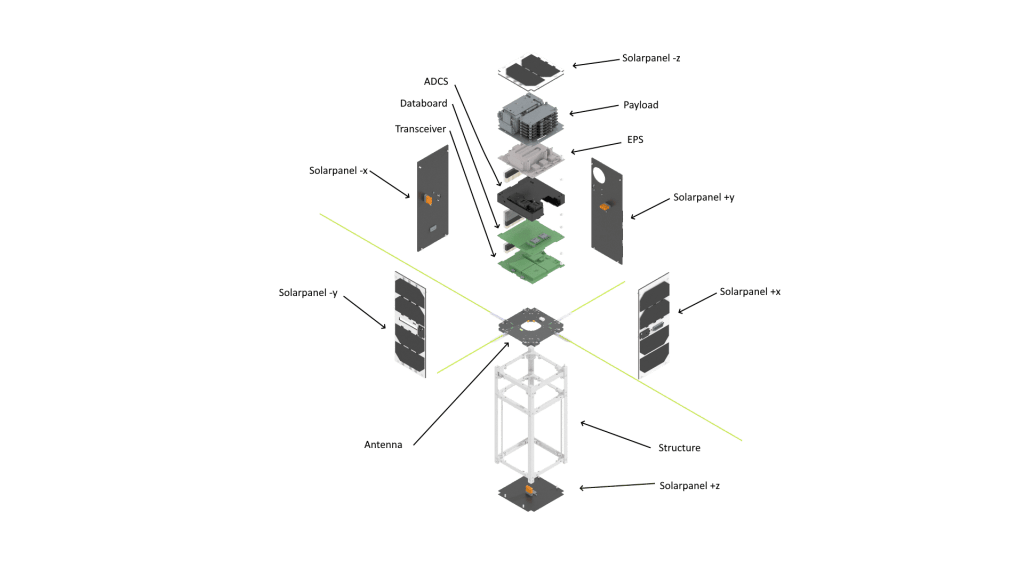
The Da Vinci Satellite team is developing a 2U CubeSat to carry out two educational experiments in orbit.
The satellite carries two payloads. The first, Dice, is a microgravity ‘dice game’ camera experiment designed to engage students and demonstrate the effects of microgravity in an accessible and interactive way. The second, Bitflip, is a radiation-induced bit-flip imaging experiment, which aims to demonstrate how space radiation can affect images produced by an onboard camera.
The satellite’s solar panels
As the team progressed with the development of their satellite, they identified visible damage to the spacecraft’s solar panels. A crack in one of the solar panels was stabilised using glue. The repair was carried out by space industry professionals experienced in similar repairs.
Since the solar panels are essential for generating the electrical power needed to operate the satellite and its payloads, the team has been carefully assessing whether the damage could affect the mission’s performance and whether a replacement panel would be necessary.
To investigate this, the Da Vinci Satellite team travelled to ESA ESTEC at the beginning of September to test the performance of the solar panels.
Testing solar panel performance at ESA ESTEC
The test was carried out with support from the Solar Generators Laboratory at ESA ESTEC. Photoluminescence (PLM) imaging was used to assess the damaged or cracked solar cells, followed by electrical performance measurements using a pulsed solar simulator, or ’flasher’, providing a light spectrum representative of sunlight in space (AM0 conditions).
All panels, including the damaged one, were tested, giving the students hands-on experience with ESA ESTEC facilities and expertise. Preliminary measurements indicate that the panels continue to perform well despite the visible damage.
Next steps for the Da Vinci Satellite team
Back at their university, the team is comparing the measurements taken at ESA ESTEC with the results of their earlier electroluminescence (ELM) test. The team will also perform another ELM test at the university to provide an additional point of comparison.
The overall results will allow them to determine whether the solar panels have experienced any additional degradation and to build a clearer picture of their current condition.
The work at ESA ESTEC is an important step for the project. By investigating the solar panel damage and working with experts from ESA and the space industry, the students are gaining first-hand experience of the challenges involved in preparing a spacecraft for flight. Assessing the panels’ performance brings the team one step closer to determining whether their CubeSat is ready to continue its journey towards space.
You must be logged in to post a comment.