
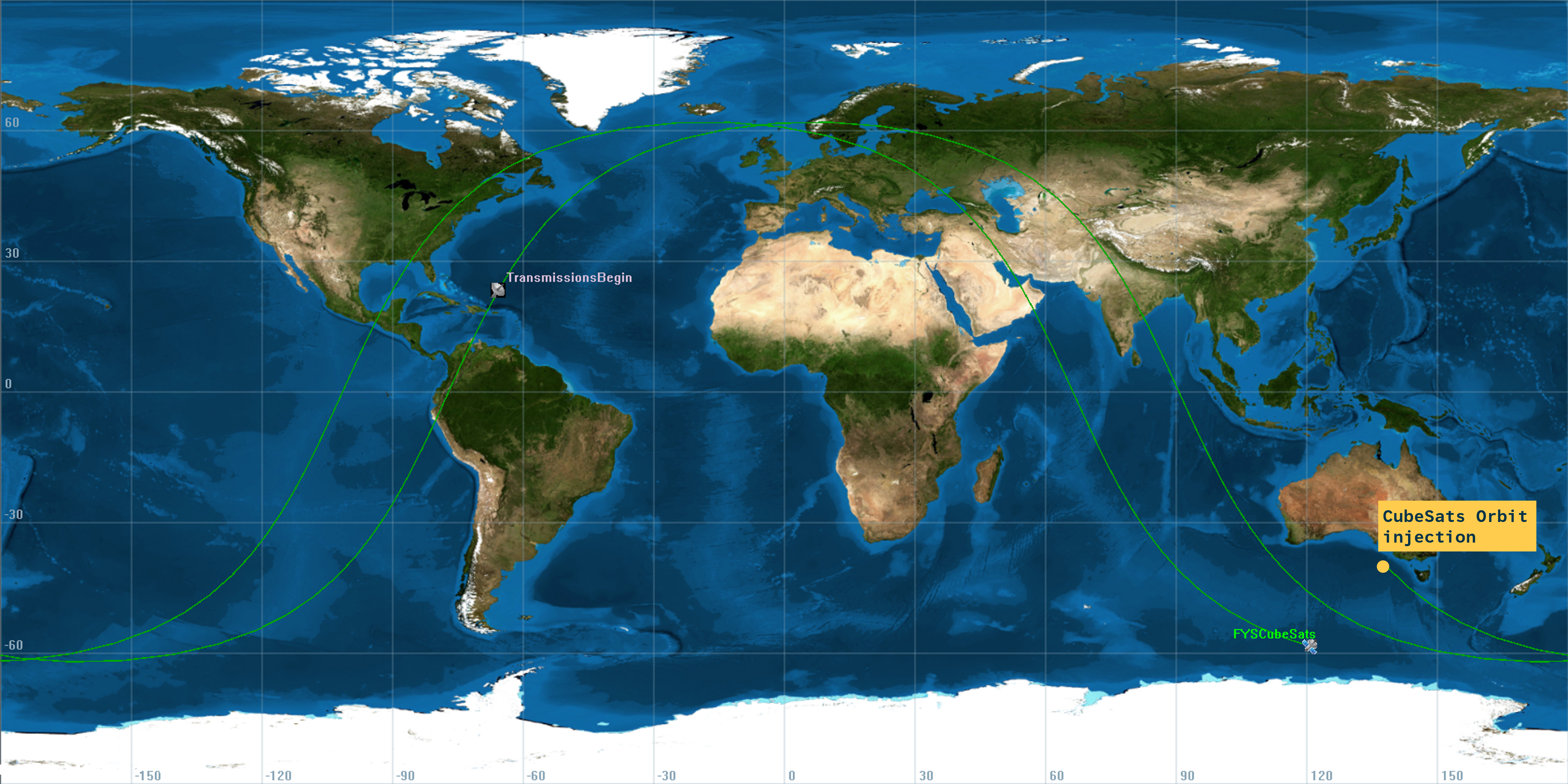
Scheduled to launch on the Ariane 6 inaugural flight, 3Cat-4 and ISTSat-1 are two 1-unit CubeSats part of ESA Academy’s Fly Your Satellite! programme. Both satellites will downlink in the UHF band, and radio enthusiasts from around the world are invited to help listen to the first signs of activity from these two satellites in orbit!
Both CubeSats are expected to be injected into a +/-580 km circular orbit with 62deg inclination approximately 65 minutes after lift-off, with the satellite’s antenna deployment attempts beginning 45 minutes later. The current estimated first possible transmissions may commence at 19:50 UTC (21:50 CEST) over the North Atlantic Ocean following a lift-off at 18:00 UTC (20:00 CEST), see figure above for an approximation of the ground track.
A preliminary set of Two-Line Elements for both missions will be published below.
TLE last updated on 9 July 2024 at 20:15 CEST.
|
1 00000U 24129FYS 24191.83744213 .00000000 00000-0 19909-3 0 01 2 00000 62.0100 161.6155 0003414 239.4100 346.8389 14.96640644000002 |

-
3Cat-4 beacon is transmitted in the UHF band, at a frequency of 437.35 MHz. The downlink is GMSK modulated at a data rate of 9600 bps. Instructions for decoding the 3Cat-4 beacon are available in the 3Cat-4 webpage: How to receive from ³Cat-4.

-
ISTSat-1 beacon is transmitted in the VHF band, at a frequency of 145.895 MHz. The downlink is AFSK modulated at a data rate of 1200 bps. Instructions for decoding the ISTSat-1 beacon are available on the ISTSat-1 page.
The first confirmed recording of 3Cat-4 and/or ISTSat-1 from each continent (Europe, Africa, Asia, North America, South America, and Oceania) within a week of launch will be rewarded with a QSL card from ESA! These “special postcards” confirm that radio contact was made, and will include acknowledgement of the help given by the winners to ESA and the 3Cat-4 and/or ISTSat-1 teams in acquiring the first signals from their satellites.
To enter this competition, please submit your recording, timestamp of passage over your ground station, and the location of your ground station via the following competition submission form.
ISTSat-1, the first Portuguese student CubeSat

The ISTSat-1 is the first nanosatellite project developed by students at the Instituto Superior Técnico / University of Lisbon in Portugal. The primary goal of the ISTSat-1 mission is to provide students with a challenging hands-on project, to advance their skill development, foster their enthusiasm for space, science, and technology, and expose them to the full project life cycle of a space mission. The secondary objective of the mission aims to demonstrate an Automatic Dependent Surveillance Broadcast (ADS-B) system to track aircraft from orbit. The ADS-B system will collect and analyse tracking data and correlate it with ground-based tracking datasets to assess whether low-cost CubeSats can act as suitable ADS-B support satellites.
³Cat-4, a small satellite for big observations

³Cat-4 is a 1U CubeSat for Earth Observation developed by students from Technical University of Catalonia (UPC), Spain. As a part of the FYS! Programme, this CubeSat’s primary objective is also to provide students with practical experience in a real satellite project, engaging and preparing them for a successful career in the European workforce. In addition, the satellite has an important scientific mission. 3Cat-4 will explore a CubeSat’s capacity to provide Earth Observation service, and thereby motivate future projects with the same purpose. In particular, the mission combines a GNSS-Reflectometer, an L-band radiometer, and an Automatic Identification System (AIS) receiver in a single platform.
For more updates on 3Cat-4 and/or ISTSat-1and Fly Your Satellite! click here.