

ESA Academy is now accepting applications from university students for the Satellite Communication Systems Training Course. Developed in close collaboration with ESA’s Directorate of Connectivity & Secure Communications, the course will be held at the ESA Academy’s Training & Learning Facility at ESA ESEC, Transinne, Belgium, from 1 to 5 March 2027.
The experience

Satellite communication systems use spacecraft in orbit to transmit and receive information between users, ground stations, and other space-based assets, providing connectivity over vast distances and across regions where terrestrial networks may be limited or unavailable.
They are essential to a wide range of applications, including telecommunications, broadcasting, navigation support, emergency response, maritime and aeronautical connectivity, and the delivery of critical services.
For Europe, satellite communications are strategically important for strengthening digital connectivity, ensuring secure and resilient communications, supporting technological innovation, and enhancing European autonomy in space and telecommunications. As satellite technologies evolve and become increasingly integrated with terrestrial networks, they will play a growing role in shaping Europe’s digital future and its position in the global space sector.

Taught by experts from ESA’s Directorate of Connectivity & Secure Communications, together with specialists from across ESA and the European space sector, the course combines formal lectures, practical exercises, technical discussions, and collaborative group work.
A central element of the training is a multidisciplinary group project in which participants design a satellite communications mission responding to realistic user requirements. Throughout the project, students apply the knowledge acquired during the week to develop a coherent mission concept and assess key technical and operational trade-offs before presenting their solution to a panel of experts.
Objectives
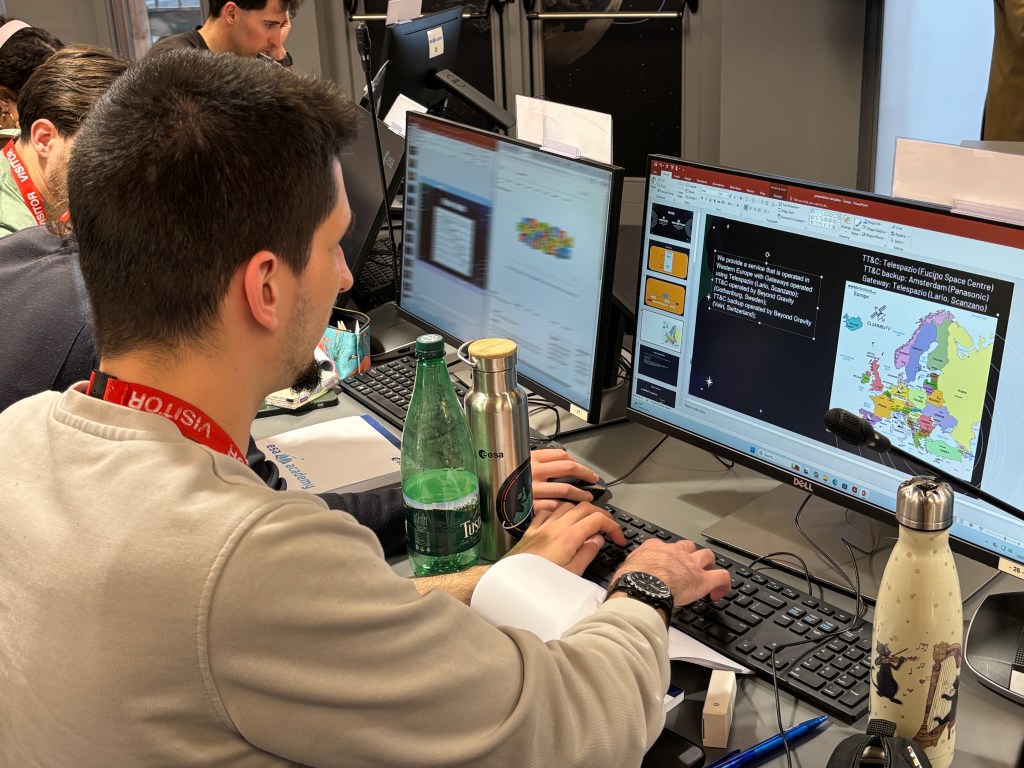
The Satellite Communication Systems Training Course provides students with a comprehensive introduction to the principles, technologies, and applications of modern satellite communications.
Participants will explore the key elements involved in the design and operation of satellite communication systems, including user and mission requirements, link budgets, payloads, antennas, ground segments, spacecraft platforms, operations, secure communications, optical communications, and emerging technologies such as 5G and 6G integration.
The course highlights the essential role of satellite communications in enabling global connectivity, secure services, and future integrated terrestrial and non-terrestrial networks.
Target audience

The course is intended for Master’s and PhD students in engineering, telecommunications, physics, computer science, and other relevant scientific and technical disciplines who are interested in satellite communications, spacecraft systems, secure connectivity, and future space-based communication technologies.
Evaluation
Upon successful completion of the course, participants will receive an ESA Academy Certificate of Participation and a course transcript. Assessment is based on active participation throughout the course and the final group project presentation, which is evaluated by a panel of experts. The course transcript enables participants to request ECTS credit recognition from their home university, subject to the institution’s own academic regulations.
Week schedule
| Day 1 | ESA and connectivity and secure communications directorate activities Introduction to systems engineering and SatCom systems SatCom link budget principles and introduction to multi-beam SatCom payload |
| Day 2 | SatCom ground segment SatCom system antenna Group project I |
| Day 3 | SatCom platform
SatCom operations Secure SatCom systems Group project II |
| Day 4 | SatCom optical systems and technologies The role of satellites in 5G and 6G networks Legal aspects Group project III |
| Day 5 | SatCom systems evolution Group project final presentation Conclusion |
SatCom = Satellite Communications
Who can apply?
Eligibility criteria
To participate, students must fulfil the following criteria at the time of application:
- be at least 18 years old. ESA Academy and relevant partners will only appraise applications from students who have no or limited professional experience in relevant scientific or other space-related topics.
- be a national of an ESA Member State, an ESA Associate Member, or Canada*
- Be enrolled in a Master’s (MSc or equivalent), or PhD programme in engineering or science for the academic year 2026-27.
- be studying any relevant subject: engineering, telecommunications, physics, computer science, etc.
Sponsorship & attendance
Sponsorship
Selected students will be required to attend the entire training course at ESA ESEC. They will be sponsored by ESA to cover accommodation and meals, as well as up to €350 for travelling to Belgium.
Canadian students
*Canadian students enrolled in a Canadian post-secondary institution may apply for additional support from the Canadian Space Agency through this Announcement of Opportunity (grant applications must be submitted at least 7 weeks before the event start date – create an account as soon as possible!). This additional support is to cover costs that are not already covered by ESA for selected Canadian post-secondary students.
Diversity and inclusion statement
ESA is committed to achieving diversity and creating an inclusive professional environment. To this end, we welcome proposals and applications from all eligible candidates irrespective of gender, sexual orientation, ethnicity, beliefs, age, disability, or other characteristics. The ESA Academy strongly encourages inclusiveness within its programmes and within participating teams, which contributes to the enrichment of our programme.
Whenever possible, we seek to accommodate individuals with disabilities by providing the necessary support, either digitally or at the location of the training. In case of any questions or specific needs, please reach out to academy.training@esa.int to get assistance or advice during the application process.
How to apply?
- Apply through ESA Learn, the ESA Education and Community Platform;
- Upload a motivation letter (PDF, maximum 1 page, no images);
- Upload a CV (PDF, in Europass format, maximum 2 pages, no images);
- Upload a formal recommendation letter (PDF, maximum 1 page, including signature, no images) from a university professor or academic supervisor. If the referee cannot provide the letter, ask them to email academy.training@esa.int directly before the deadline;
- Upload a Transcript of Grades from the two previous semesters or, if these are not available, from the previous graded academic year if not available (PDF). The transcript may be submitted in the university’s language if an English version is unavailable.
All answers and documents must be in English, except the Transcript of Grades.
Important dates
| Application deadline | 6 December 2026, 23:55 CET |
| Selection announcement | 4 January 2027 |
| Course dates | 1–5 March 2027 |
Before you apply
Accommodation
- Participants will stay at Mercure hotel in Han-sur-Lesse.
- The hotel will be provided and paid for by ESA.
- Students will be assigned shared rooms with participants of the same gender.
Arrival and departure
Arrival:
Students are expected to arrive at Rochefort-Jemelle train station on Sunday, 28 February 2027.
Departure:
- Either Friday, 5 March 2027 after 16:00 CET (from Rochefort-Jemelle train station), or
Important:
Selected students are required to attend the entire course from start to finish.
Transportation during the course
ESA will provide and pay for a bus service for participants:
- Morning: Hotel → ESA ESEC-Galaxia
- Evening: ESA ESEC-Galaxia → Hotel
 English
You must be logged in to post a comment.