
“Participating in the REXUS/BEXUS Programme is a fantastic opportunity to get hands-on experience in a multidisciplinary team while building an experiment which will fly to the Stratosphere! It gives the opportunity not only to apply knowledge but also to learn new skills and contact with experts who are here to help the experiment succeed.” ROCSAR team
ROCSAR experiment
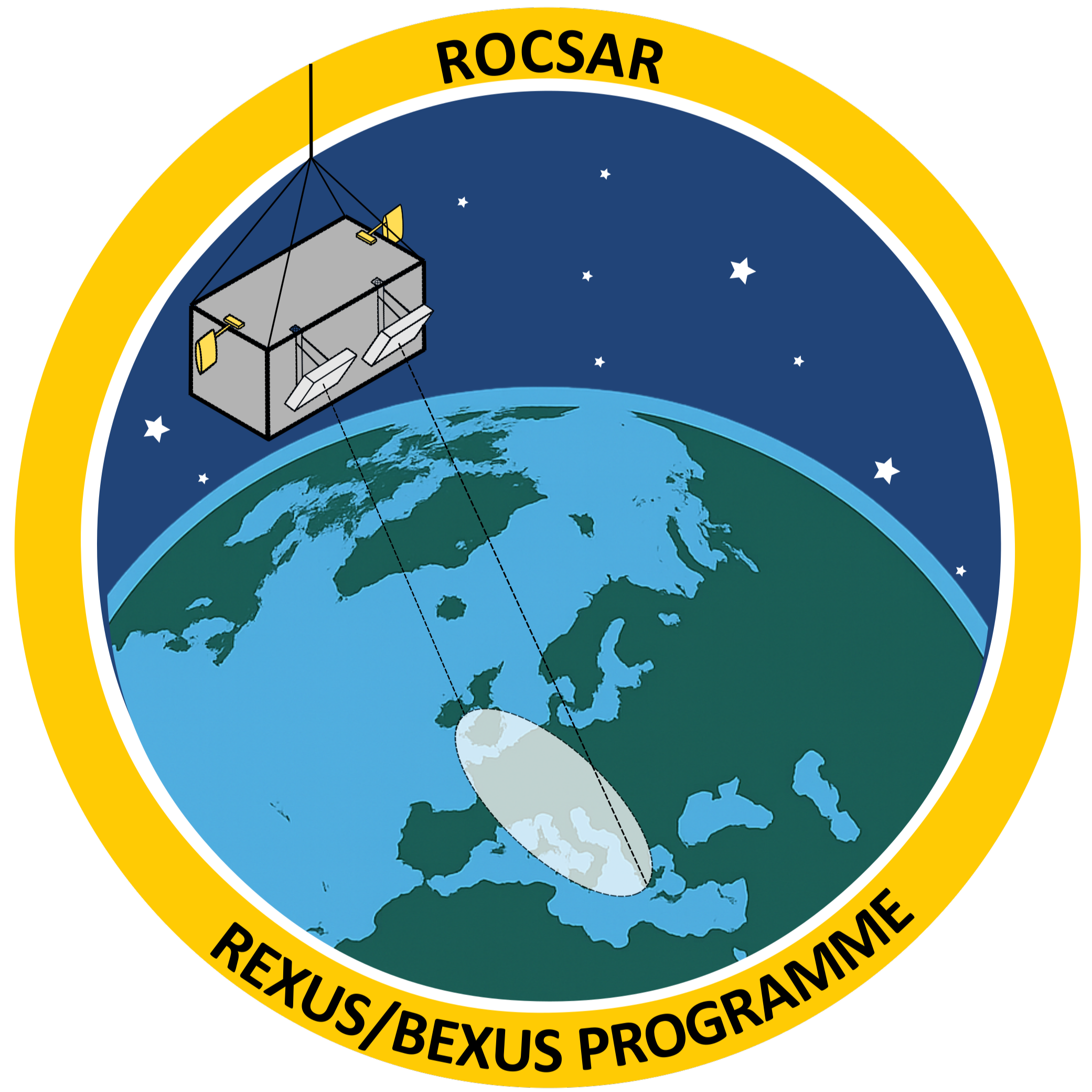
ROCSAR (Rotation Compensated Synthetic Aperture Radar) is a university student experiment designed to demonstrate high-resolution terrain radar imaging from a stratospheric balloon platform using Synthetic Aperture Radar (SAR).

SAR is a technique that exploits the motion of an antenna over a target area to produce high-resolution images of the ground, normally associated with satellites and aircraft. One of the key challenges in adapting SAR to a balloon platform, in this case the BEXUS gondola, is the gondola’s natural residual rotation, which continuously misaligns the antenna pointing direction during acquisition and degrades image resolution.
The experiment uses two specially designed resonant cavity antennas operating in the C-band, one for transmission and the other for reception, mounted on independent rotation axes, each actuated by a servo motor, and designed to survive the harsh stratospheric environment.
The ROCSAR antenna system is connected to a custom radio-frequency (RF) front-end and is rotated in real time to compensate for the gondola’s motion, keeping the antennas pointed at a desired fixed area on the ground. During each acquisition session (around 25 s), the ROCSAR experiment will transmit a series of radar signals toward the ground scene using a commercial off-the-shelf software-defined radio platform and record the backscattered echoes, which are later processed to create a SAR image.
The ROCSAR team

The ROCSAR team is participating in Cycle 17 of the REXUS/BEXUS programme and comprises eight students from the Faculty of Engineering of the University of Porto (FEUP), one of Portugal’s leading universities. The team spans two engineering disciplines, electrical and mechanical engineering, at Bachelor’s, Master’s and PhD level, covering different domains: RF and electronic design, software, antenna development and structural engineering.
The team is responsible for the entire experiment cycle, from conception to design, testing, assembly and in-flight operation during the BEXUS launch campaign, while following the rigorous REXUS/BEXUS schedule, which includes formal reviews such as Preliminary Design Review (PDR), Critical Design Review (CDR), Integration Progress Review (IPR) and the Experiment Acceptance Review (EAR).
ROCSAR in a nutshell
| Experiment | ROCSAR |
| Objective | To demonstrate rotation-compensated Synthetic Aperture Radar (SAR) imaging from a stratospheric balloon platform by actively counter rotating the antennas to maintain stable pointing during acquisition and produce high-resolution terrain images. |
| University, country | Faculty of Engineering of the University of Porto (FEUP), Portugal |
| Social media | ROCSAR on Instagram ROCSAR on LinkedIn |
You must be logged in to post a comment.