
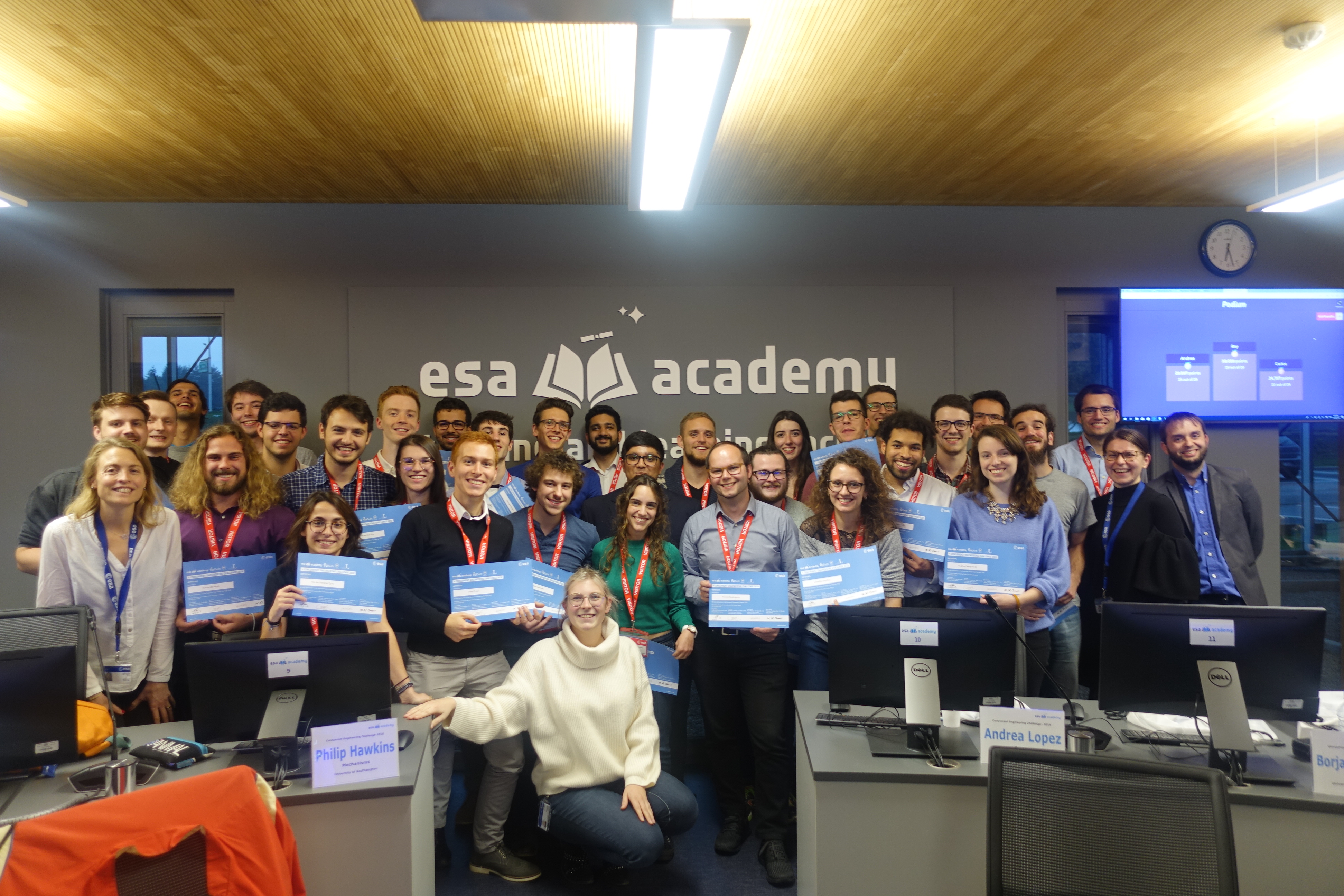
ESA is looking for three universities from ESA Member States which would like to participate with their students in the fifth ESA Academy’s Concurrent Engineering Challenge. This Challenge will be organised by the ESA Education Office in collaboration with ESA’ Systems and Concurrent Engineering Section. The event will last five days and take place during 2024 depending on the availability of the selected universities.

“Concurrent Engineering (CE) is a systematic approach to integrated product development that emphasises the response to customer expectations. It embodies team values of co-operation, trust and sharing in such a manner that decision making is by consensus, involving all perspectives in parallel, from the beginning of the product life-cycle.”
With respect to traditional design methods, the Concurrent Engineering approach uses a dedicated process and facility, a multidisciplinary team, and an integrated design model so that all subsystems are able to perform the design in the same room, at the same time. This is a far more efficient way of designing but comes with its own difficulties. A consistent set of design parameters are defined and exchanged throughout the process and any changes that could impact the design on another discipline are identified, communicated, and assessed with the entire team. Although Concurrent Engineering is a more complicated process to begin with, in effect it allows for design challenges to be identified earlier, therefore reducing the overall design time.
ESA’s main Concurrent Design Facility (CDF) is located at ESA’s Space Research and Technology Centre (ESTEC) in the Netherlands.
At ESA Academy’s Training and Learning Facility located at the ESA Education Training Centre (ESEC-Galaxia) in Belgium, ESA has developed a similar facility exclusively for educational purposes.
Details of the Challenge
The ESA Academy’s Concurrent Engineering Challenge 2024 will feature four groups of 20-30 University students at Master or PhD level. A first group will be selected, at a later stage, by ESA to participate from ESA Academy’s Training and Learning Facility. The three other groups will be identified by the universities and will participate from their respective Concurrent Engineering Facilities (CEFs).
Each group will be supervised by two local systems engineers and will be given, at the start of the Challenge, the same space mission to design within five days. Students in each group will be divided into small teams of two or three to cover the following disciplines:
-
structures,
-
configuration
-
power
-
mechanisms,
-
thermal
-
payload
-
attitude and orbit control
-
propulsion
-
trajectory analysis
-
communications and data handling
Students within each small team will design their subsystem using the Concurrent Engineering approach with the objective of complying with the mission requirements and prove feasibility.
The groups will not compete against each other but will rather use video conferencing and live messaging forums to share each day’s progress, raise any particular challenges they are facing, and receive feedback from the other participants. At the end of the week, each group will present their final design to the others.
Preliminary schedule of the Challenge:
|
Day 1 |
Introduction to the Concurrent Engineering Approach |
|
Day 2 |
System requirements and mission architecture |
|
Day 3 |
First iteration of all subsystems |
|
Day 4 |
Second iteration of all subsystems |
|
Day 5 |
Final design consolidation & any open issues |
Universities involved in the Challenge will benefit from the advice of ESA to develop their CEF and to learn how to organise a Concurrent Engineering study with University students. They will also be offered several tutorials to learn about the Concurrent Engineering approach and its benefits, as well as the Concurrent Model-based Engineering Tool (CoMET). Several preparation meetings will be organised by video conference between ESA and the participating universities, and they will be involved in the selection of the mission to be studied.
Certificates of participation will be sent to each university to be distributed to the participants. The certificates will have the logo and signature of each participating university and ESA.

How to apply
In order to participate, universities should fill in the application form and must fulfil the following criteria:
-
Be located in an ESA Member State;
-
Have a CEF facility or commit to develop one for the Challenge;
-
Have or commit to have a network of more than 15 dedicated computers in this facility;
-
Have or commit to have capabilities for video conferencing (large screens, microphone(s), cameras, loudspeakers,) in this facility;
-
Use CoMET or commit to install the tool and learn how to use it before the Challenge;
-
Have a professor appointed to coordinate the preparation and organisation of the Challenge at the University;
-
Have two professors with some design knowledge and familiarity in space systems appointed as systems engineers for the Challenge. They should be willing to learn the Concurrent Engineering approach and CoMET, and be available for the entire duration of the Challenge, as well as to participate in the preparation meetings;
-
Have technician(s) to support the use of CoMET, live forums and video conferencing system during the Challenge;
-
Identify a potential group of 20-30 participating MSc or PhD students in the University;
-
Have support material to assist students during the design sessions such as books and specific domain software (for example CAD or trajectory analysis software);
-
Commit to collaborate with ESA and the other participating universities during the preparation and organisation of the Challenge, to attend the meetings and to meet the milestones:
-
2-3 months before the Challenge: the CEF should be ready and operational.
-
1-2 months before the Challenge: the CoMET and related calculation sheets should be installed and the two systems engineers should be familiar with the material and the Concurrent Engineering approach.
-
1 month before the Challenge: students should be identified and information about participants should be provided to ESA.
The deadline for applications is 3 July 2023, 23:59 CET.
For more information, please contact tlp@esa.int and have a look at the results of the 2022 Challenge.
 English