
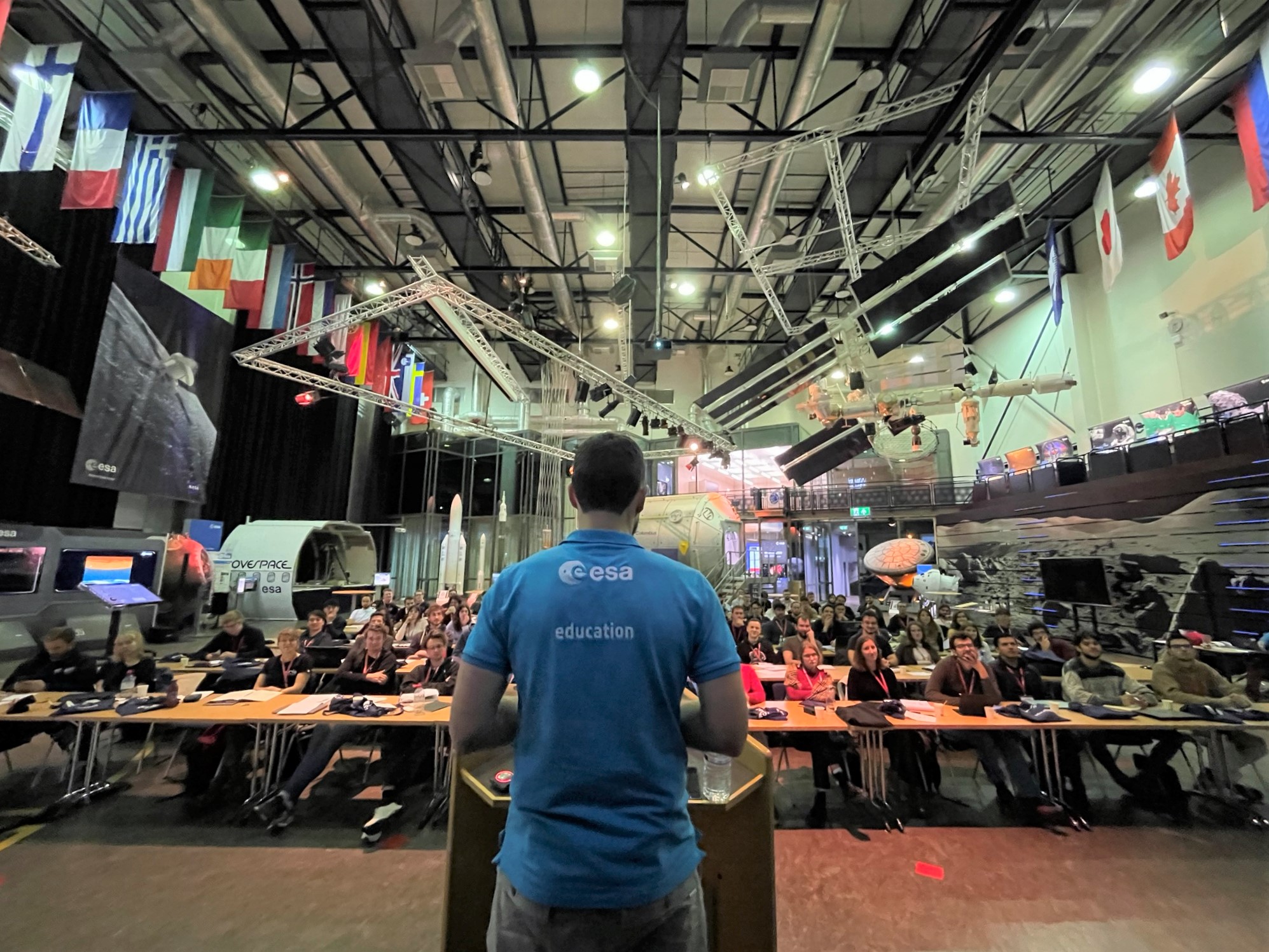
12 candidate CubeSat teams have successfully completed the Training Week of the pilot edition the Design Booster Programme. Held at ESTEC, Noordwijk, from 7-11 November 2022, shortlisted teams were invited to follow lectures offered by ESA experts, focused on university CubeSats projects’ design.
A Fly Your Satellite! spin-off, Design Booster is aimed at CubeSat teams with a preliminary design that want to benefit from support from ESA for the consolidation of their detailed design.

With the Design Booster programme, ESA Academy targets new audiences and enable less experienced teams to progress in the steep learning curve which is a satellite mission. In the call proposals, student teams were invited to reflect how their mission objectives were aligned with the UN Sustainable Development Goals and the ESA technological roadmaps. Teams showed great ambition and foresight, proposing missions aligning with new and emerging trends in the space sector, often aiming to address the issues of tomorrow. The FYS programme hopes to foster these teams’ aspirations, with the intention that these students go on to perform missions which are both highly educational but also contribute to the future of the space sector.

Shortlisted teams are still in the early stages of design, developing various space missions focused on different applications. Among the pool of candidate CubeSats, mission objectives vary from Earth observation, to space debris, telecommunication, in orbit technology demonstration, artificial intelligence, astrophysics, biology, and many others, often using cutting-edge technologies and components built in-house.
“The training week at ESTEC gave our team lots of useful information for the upcoming weeks and months,” explained a participating student. “It also demonstrated once again how many little details actually go into the design and construction of any spacecraft, even ‘small and simple’ CubeSats.”
The participating teams were:
|
Team |
University |
Country |
|
6S |
Politecnico di Milano |
Italy |
|
AlbaSat |
Unversità degli di Studi di Padova |
Italy |
|
Antaeus |
University of Coimbra |
Portugal |
|
AstroJam |
University of Nottingham |
United Kingdom |
|
BioSat |
Norwegian University of Science and Technology |
Norway |
|
BIXO |
University of Vigo |
Spain |
|
Estigia |
Universitat Politècnica di València |
Spain |
|
LEDSAT 2 |
Sapienza University of Rome |
Italy |
|
ROSPIN-SAT-1 |
Politehnica University of Bucharest |
Romania |
|
SAGE |
ETH Zurich |
Switzerland |
|
ST3LLAR-Sat1 BOIRA |
Universidad Carlos III de Madrid |
Spain |
|
TRACE |
Technische Universität Darmstadt |
Germany |
36 hours of educational content across the five days saw ESA experts help the students to consider the full project lifecycle at the design stage, in terms of engineering, resources and expertise, which will translate into smoother planning and execution of verification activities as well as more robust in-flight operations. Lectures and workshops covered a wide range of varied content, both with system disciplines (Systems Engineering, AIV, Project Management) and with sessions on subsystem design (power, structures, software, etc.). Furthermore, sessions focused on those less technical aspects were also planned, such as Legal and Regulatory aspects in CubeSat missions, Communications and Outreach, and Lessons Learned from students already in advanced stages of their mission.

There were also opportunities to visit ESTEC facilities such as the Concurrent Design Facility (CDF) and the Propulsion Laboratory, as well as following a live pass of the OPS-SAT CubeSat mission remotely with operators from ESOC.
“Being able to see all those talented groups, coming out with fascinating missions, has been an invaluable experience,” said one of the students. “The opportunity that ESA grants through FYS Design Booster is simply incredible. There has been an expert for every single topic related to a CubeSat mission, and for that reason I really thank the ESA Academy staff for making this event possible!”
A panel of ESA experts assessed the proposals from shortlisted teams, on an online Selection Workshop that took place on 6 and 7 December 2022. Once selected teams are announced, they will then get to move on into the first milestone of the FYS Design Booster programme, the Baseline Design Review.
As a team summarised it, “The FYS Design Booster Training Week was an unforgettable experience with an educational return that exceeded the expectations! The environment cultivated a lot of growth through direct teaching methods, interactive workshops, and networking opportunities with experts and other teams.”
-
For more information about upcoming Design Booster activities, please visit https://www.esa.int/Education/CubeSats_-_Fly_Your_Satellite
-

6S – Politecnico di Milano – Italy -

AlbaSat – Unversità degli di Studi di Padova – Italy -

Antaeus – University of Coimbra – Portugal -

AstroJam – University of Nottingham – United Kingdom -

BioSat – NTNU – Norway -

BIXO – University of Vigo – Spain -

Estigia – Universitat Politècnica di València – Spain -

LEDSAT 2 – Sapienza University of Rome – Italy -

ROSPIN-SAT-1 – Politehnica University of Bucharest – Romania -

SAGE – ETH Zurich – Switzerland -

ST3LLAR-Sat1 BOIRA – Universidad Carlos III de Madrid – Spain -

TRACE – TU Darmstadt – Germany
 English